((Leer es ESPAÑOL))
There is a moment in artistic work that happens in solitude, while we are inside our own introspective process. Ideas appear in the street, in a museum, in the studio, in front of a piece, an image, or a text. But there is another moment that, for me, is just as important: the one that happens when we share and expose ourselves to others. The moment when we first show the work, the doubts, the discoveries, the things we are looking at. Talking about art, life, philosophy, and process. Showing a piece that is not finished yet, or listening to what someone else is working on. Laughing at an absurd idea. Doing something simply because we feel like doing it.
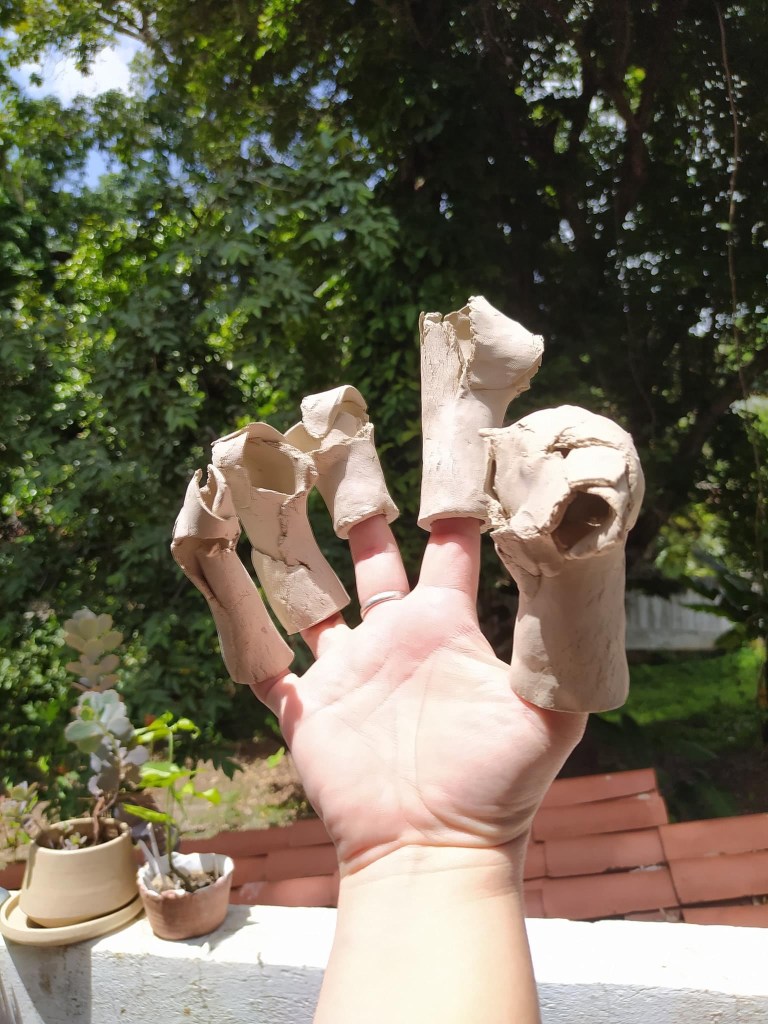
This image came out of one of those days. I took it in 2022 at Acción Cerámica, in Caracas, when I shared that space with so many people: students, artists, ceramicists, friends. Daniel had made these small amorphous figures and, as soon as I saw them, without thinking too much about it, I put them on my fingers, stepped out onto the studio balcony, and took the photo.
Three years later, I came across that image again, one I still like so much, and decided to make this little video with artificial intelligence. Again, without too many expectations. Just to play, because it made me laugh, because I wanted to see what could happen.
And maybe that is exactly where something we sometimes forget when we talk about creativity begins.
Marián Angulo —@aangulo— wrote in her October 11 email this year about the relationship between creativity and fun. For her, the two are deeply connected, and she also speaks about creating from the calmness of play. I like that idea because it brings the creative act back to a less solemn place: experimenting, trying things, making mistakes, having fun, and allowing things to appear that we probably could never have planned.
Actors know a lot about this, for example. Playing is part of their work. Trying an action, changing it, exaggerating it, getting it wrong, repeating it, reacting to what someone else does. Very often, something appears precisely because it was not being consciously searched for.
I also think that this state is nourished by other people.
During the years when I shared spaces like Acción Cerámica, many ideas came out of conversations that seemed unimportant at the time. Watching what someone was doing at a nearby table. Talking while we worked. Asking: how did you solve this?, what are you reading?, what did you see?, what are you interested in lately? Discovering materials, artists, books, and different ways of thinking because someone else placed them in front of us.
Daniel —@danielguerra.art— made these figures. I saw them, loved them, and immediately decided to put them on my fingers and click the camera shutter on the studio balcony. Years later, an artificial intelligence tool recreates them in motion.
That small journey is also a creative process.
That is why I value more and more having people close to me with whom I can talk about what we are doing, especially when the path becomes increasingly solitary for those of us who have emigrated. Keeping that contact, not necessarily to receive opinions or seek approval, but simply so that ideas can keep circulating.
I believe creating also needs those informal spaces and, above all, it needs to preserve something of play. Because sometimes we are so concerned with making a good work, building a language, developing a project, or finding meaning that we forget something much more basic: we also started making things because making them is fun.


Leave a Reply