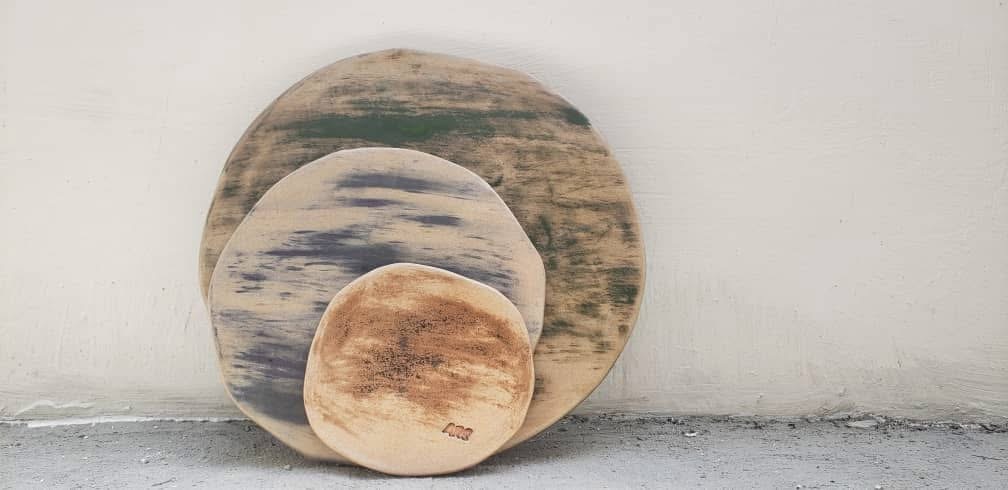
A few days ago, I was talking with a ceramic artist friend about language—about that personal signature that allows you to look at a piece and immediately say: this is so-and-so’s work.
From the moment you enter art school, one of the most persistent questions is how to find a language of your own. All of us—because I don’t think anyone escapes it—go through that moment of uncertainty: looking outward and looking inward, trying different paths, wondering what makes a work, or a way of making, unique.
The search can feel long, even confusing. Sometimes it seems as though that personal language exists somewhere far away, waiting to be discovered once and for all.
My experience has been different. Language has never come to me as a revelation. It has been years of working and working, while paying attention to my processes, my interests, and the things I naturally gravitate toward. My path has been much quieter: step by step. And it is precisely in what keeps returning that I have begun to recognize it.
Rilke wrote about inner necessity as the origin of creative work. I have always found that idea powerful. There are forms, materials, and processes that return to our hands again and again, even when we try to move away from them. We return because there is an affinity there, an open question, something we have not yet finished exploring.
I think about this when I work with slabs. There is something about a simple slab that has attracted me for a long time. I am drawn to its frontality, its economy, and the direct way it occupies space. I also love tiles and flat forms, whether symmetrical or asymmetrical. There is something about them that I always experience as an invitation.
A surface can become many things. It can be territory, image, fragment, object, sign. It can receive color, drawing, texture, or remain almost bare. Its boundaries are there, perfectly visible, yet within them there is still so much room.
Anni Albers understood very well that material also teaches us. The work happens in that dialogue between what we imagine and what the material allows, suggests, or even contradicts. In that sense, the slab has become more than simply a technique for me. It has also become a way of thinking. Working with it makes me pay attention to the edge, the thickness, the weight, the surface, the contour. It makes me decide how much to intervene and how much to leave untouched.
That affinity gradually became visible through practice. This is why I have begun to think that finding a language of one’s own may have a great deal to do with paying attention. Paying attention to what insists on returning.
To the images that come back.
To the gestures we repeat.
To the forms we keep drawing.
To the materials we return to without quite knowing why.
In these recent pieces, flat moons have begun to appear. They are very simple forms, almost signs. I like that they retain the strength of a silhouette while, at the same time, opening up an imaginary space.
Agnes Martin worked for decades with structures that returned again and again: lines, grids, subtle fields, minimal variations. That repetition never meant doing exactly the same thing. On the contrary, each return sharpened the eye. I think there is something important there. Repetition is a way of investigating, and that is no secret.
Discovering a language of one’s own also means recognizing certain loyalties. Some are thematic. Others are formal. Some can be found in the way we touch the material, in a particular kind of surface, in a proportion, a rhythm, or a form that insists on returning.
In my case, slabs, flat forms, tiles, and ceramic murals are drawing a small constellation that I continue to follow closely. I still don’t know exactly where it leads, and perhaps I don’t need to know. For now, I am interested in continuing to observe what returns, working with it, and allowing each piece to take me a little further.
Perhaps finding a voice has a great deal to do with this: recognizing the forms that call to us, following them for long enough, and allowing them, little by little, to teach us how to speak.


Leave a comment