A creative self-discovery exercise
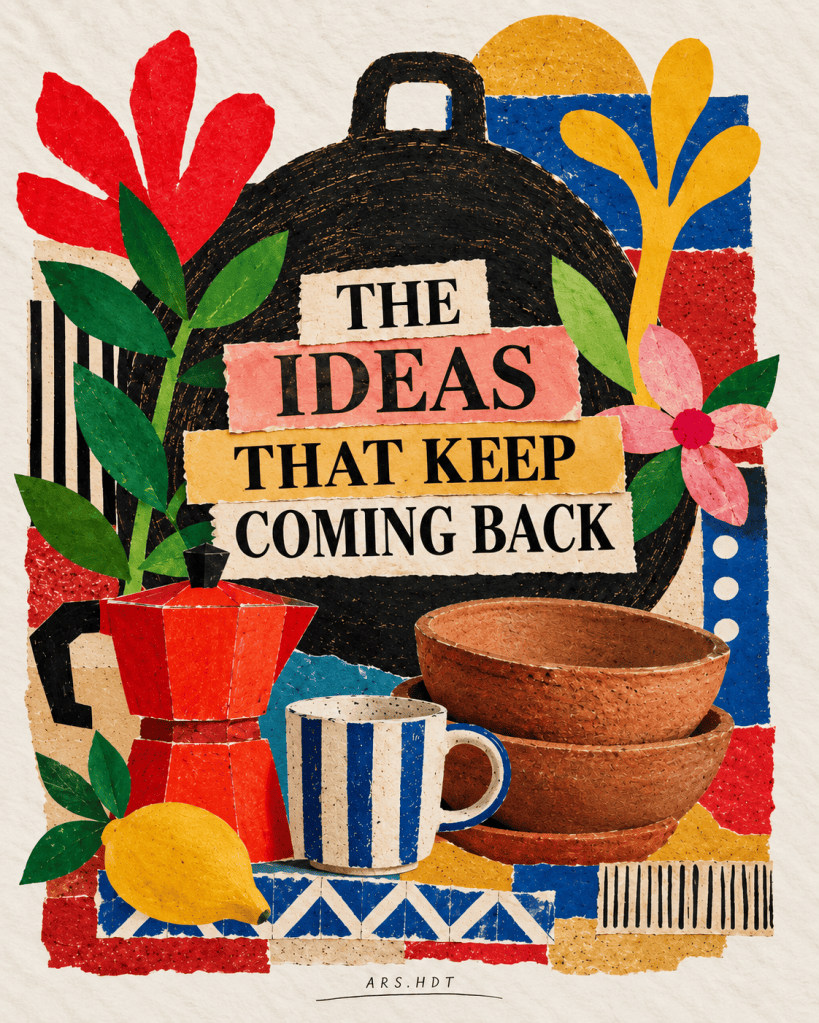
There are moments when making work is not enough. I also need to stop and look back: to observe what I have made, what I continue to make, the images that appear again and again, the questions I cannot seem to let go of.
This exercise grew out of that need.
I did not want to write a traditional artist statement or try to define my work once and for all. I was interested in something simpler and, at the same time, a little more uncomfortable: recognizing the ideas that keep coming back.
Because some things change. Materials change. Projects change. Techniques change. The places I work from change. And yet, beneath all those transformations, certain constants begin to emerge. A kind of personal vocabulary that we build almost without realizing it.
First came the act of looking.
Before clay, there was theater. Before ceramics, there was photography. For a long time, I learned to observe before I learned to make. I learned that an image can contain an entire story, that space speaks, that light alters what we see, and that silence can also be a form of language. Looking is still, perhaps, the first tool in my work.
Then came the scene.
I never completely left theater behind. Even though today I work with clay, watercolor, photography, or paper, I still think in terms of bodies, paths, tensions, entrances, and exits. I think about how a work occupies a space and how that space changes the experience of the person who encounters it.
Then I realized that one of my deepest obsessions was not ceramics alone.
It was matter.
How it begins. How it changes. How it transforms. How it moves through processes and eventually becomes an object, an image, a memory, or culture. Perhaps that is why I can move from clay to paper, from watercolor to collage, without feeling that I am abandoning one discipline for another. What interests me remains the same: transformation.
There are also objects.
The ones we use every day. The ones that break. The ones we inherit. The ones that pass from one pair of hands to another. I have always been drawn to the idea that everyday objects can tell the story of a person—or even of an era—better than many monuments can.
And alongside them are crafts and trades.
I deeply admire those who devote years, sometimes an entire lifetime, to learning how to make something with their hands. Artisans, cooks, luthiers, potters. I am moved by knowledge passed down from generation to generation, by forms of knowing that do not depend on the idea of individual genius, but on repetition, experience, observation, and time.
There is also fire.
In ceramics, fire is a real process of transformation, but for me it also works as a metaphor. Fire involves risk, patience, and trust. There comes a moment when you can no longer fully control what will happen. Perhaps that is why it interests me so much: because making also means learning to accept what cannot be completely controlled.
Then there are peoples and cultures, the many different ways of answering questions that are, at their core, universal.
How to cook. How to build. How to say goodbye to our dead. How to live. I am interested in seeing how the same material can travel across geographies, cultures, and generations and produce entirely different stories.
And inevitably, we arrive at memory.
Not as something fixed in nostalgia, but as something we continually reconstruct. Migration made me think much more deeply about this: about the ways we try to preserve certain things while others disappear, about how we rebuild fragments, and about how memory itself can be shaped with our hands. It can break. It can transform. It can be built again.
Finally, there is time.
Everything I do requires slowness and pauses. Researching. Writing. Painting. Modeling. Waiting.
I understand more and more that time is not an obstacle to my work. It is part of the work.
Perhaps that is why this exercise is not meant to bring anything to a close. Quite the opposite. I see it as a provisional map. An attempt to identify what sustains my creative universe today and to understand where it might lead me next.
Statements can change too. Obsessions can shift. Some ideas will disappear, while others will begin to take their place.
But for now, these are the ones that keep returning.
My creative universe is in constant metamorphosis.
My obsessions are the beginning of what is yet to come.

 ars hdt
Leave a comment