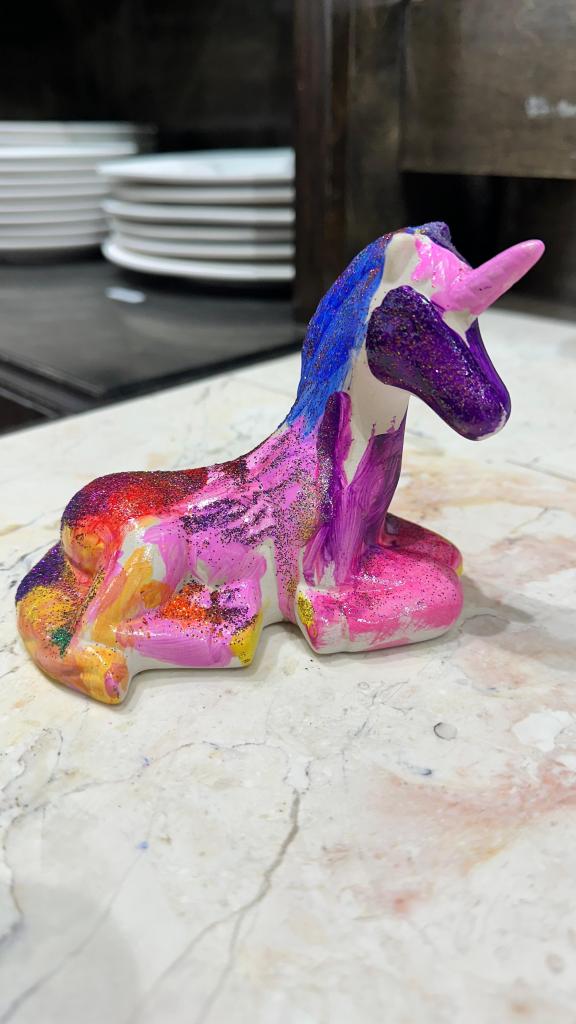
When you emigrate, being able to do what you love often feels like a rare fortune. A year after arriving, I managed to have a small studio of my own. Today, I work in a ceramics shop inside a shopping mall, a place where people come to paint their own bisque pieces. Different ages, stories, and motivations converge there, all crossed by a shared sense of excitement and curiosity that I find deeply enchanting.
They choose their pieces carefully, almost as if selecting a tattoo or a treasure: something that will accompany them, a memory of love, a family keepsake, an object charged with future. There is a four-year-old girl who visits me almost every Tuesday after her swimming class. Her father brings her, and together they take the day’s choice very seriously: a mug, a unicorn, a tiny house. Her pieces are, so far, my favorites. The freedom with which she chooses colors and immerses herself in painting amazes me. There is no judgment—only form, emotion, and play. She has told me she already has a small exhibition space reserved just for her pieces.
And so, between layers of glaze and conversations with all kinds of people, between laughter and melancholy, I begin to understand that this path is a form of encounter: with creation, with matter, with the intimate need to do something with one’s own hands and emotions.
There is something divinely simple—almost innocent—about bisque pieces ready to be painted, as if they did not yet know who they are going to become. White, silent, waiting only for a gesture of color. There is no need to wedge clay or center it on the wheel: it is enough to arrive with clean hands and a mind ready to create.
In the 1980s, in my country, painting bisque pieces cold was almost a collective fever. Many of us did it. Figures from every season appeared one after another: Easter bunnies, Christmas angels, cats, dogs, clowns. And with them came small workshops on every corner—spaces filled with the smell of paint, AM radio music, and the laughter of makers absorbed in their processes. I clearly remember my first piece: a dog lying down, so tender it seemed to exist on its own. I have always loved animals. That piece was followed by a few others, until I arrived at my first sculpture class at university. Painting bisque faded into oblivion… until I migrated and began this new job, seeking to remain close to ceramics and their processes.
That is why, when I return to the low-fire path—to color, free gesture, and imperfection—I reconnect with that same pulse. No longer from innocence, but from an awareness of what it means to create with the hands: to make the invisible visible, to give form to what we feel. I have thought a great deal about starting this project focused solely on the decoration of ceramic pieces. I am interested in playing with different surface techniques, exploring how creation emerges from an already established form, how gesture, color, and decision transform what is given into something personal.
A simple project @ars.hdt2 (Instagram profile), rich in tradition, shared knowledge, and enjoyment. A learning space without grand ambitions, where experience, the hand, and emotion matter more than the final destination of the object.

 ars hdt
Leave a comment